



The Art Gallery of Ontario’s new exhibition, David Blackwood: Myth & Legend, celebrates the life and work of one of Newfoundland’s most beloved printmakers, highlighting how Blackwood transformed the stories, landscapes, and people of his home province into powerful images that preserve a sense of history and belonging.
Curated by Alexa Greist, the AGO’s Associate Curator and Head of Prints and Drawings, the show is divided into three parts: Home, Short Stories, and The Printmaker. Each section looks at a different stage of Blackwood’s life and the ways Newfoundland shaped his art.
“The way I chose it,” Greist said, “I actually printed out the entire list of everything we had. The collection started with that, and I started with my three themes. Home felt right as the beginning, because it’s where David was from and where his art was first born.”
Home focuses on Blackwood’s early years in Wesleyville, a small fishing town in Newfoundland. After opening his own art school, he began studying printmaking at the Ontario College of Art in 1959. One of Blackwood’s early etchings, Survivors (1961), already displayed what would become central themes in his work — the sea, memory, and loss. For more than a decade, Blackwood revisited the 1914 sealing disaster off Wesleyville, where seventy-eight men from the SS Newfoundland were lost to the ice. The tragedy left a mark on both his community and his art.
Greist, who specializes in printmaking, also wanted visitors to understand the technical side of how Blackwood’s work was created.
“The etching bites through the surface bit by bit,” she said. “I would say his work is layered — both in meaning and in making.”
The second section, Short Stories, explores more personal themes. Visitors can hear Blackwood’s voice in a 1976 National Film Board documentary as he pulls a print from the press. To further engage the audience’s senses, two scent boxes — created with Dr. Melanie McBride from Toronto Metropolitan University — release smells inspired by the coast and Blackwood’s studio.
“We had previously talked about the scent of ambergris,” Greist said, “and [McBride]she created a scent that encompasses the idea of being in David Blackwood’s studio. And it does smell like a studio — and as a print geek, I love that smell.”
For visitor Claire, what stood out most from this section of the exhibit was Blackwood’s connection to location.
“His sense of place was really important, and him always coming back to it,” she said. “Newfoundland is a very special, unique place, so I’m not surprised it nourished him during his career…I do like that one room is based on storytelling — and I liked the title Myth and Legend because Canada’s landscape is intrinsic to myth-making.”
The final section, The Printmaker, focuses on Blackwood’s later years and his mastery of the medium. It includes his copper plates — showing how each print changes from one impression to another — and a video by Newfoundland artist Jerry Ropson, who created a tribute piece for him.
Here, visitors can also see a handwritten note found in Blackwood’s studio:
“At this point we have no idea of what lurks beneath the surface! Regardless, there is never disappointment.”
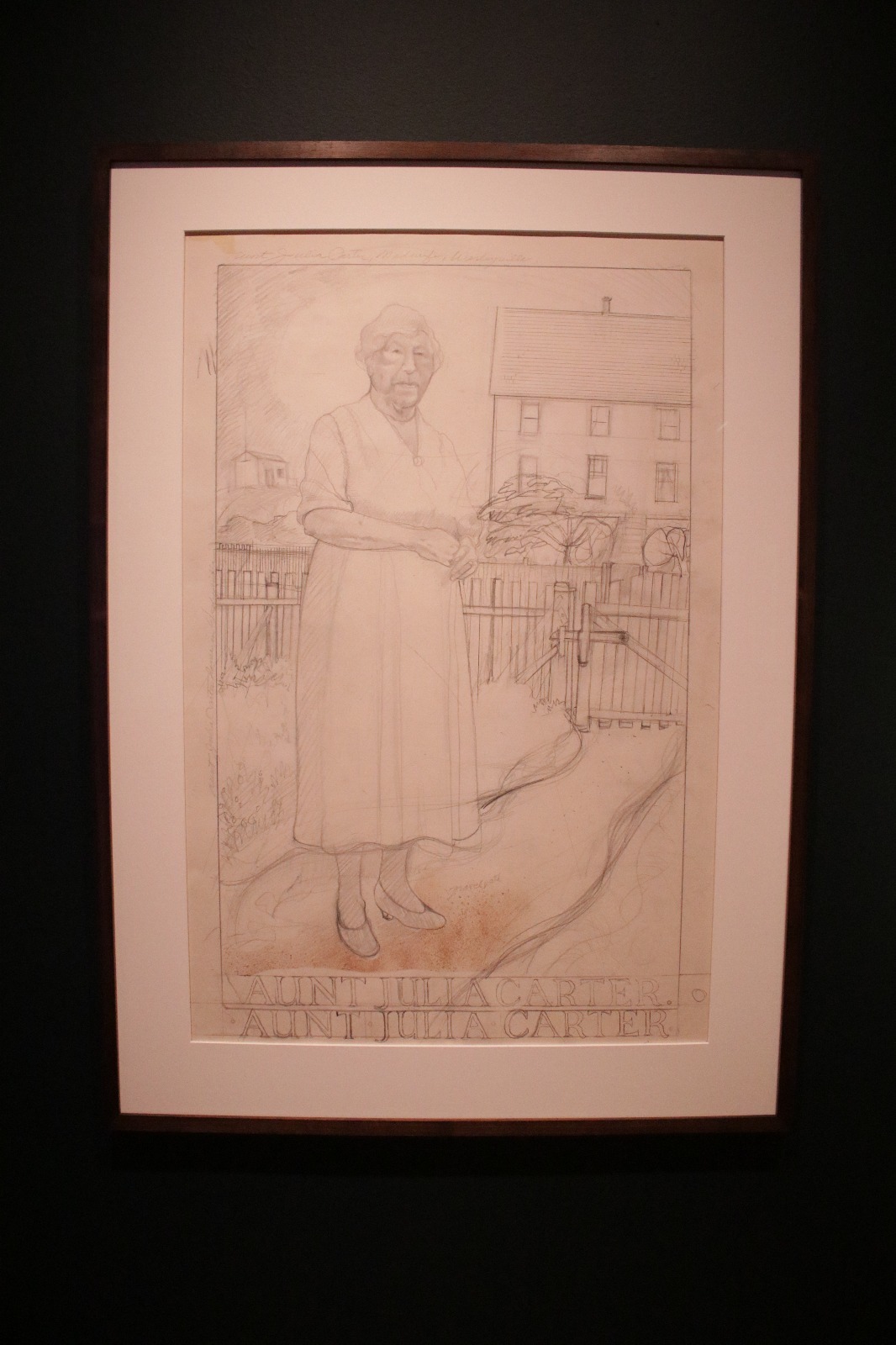
The note dates back to 2014, when Blackwood was very ill and could barely paint. Even then, he asked for his watercolor supplies. His final drawing depicted Aunt Judy Carter, the woman who gave him his first set of paints and encouraged him to become an artist. He passed away before turning the drawing into a painting.
The moment brings the exhibition full circle, linking the woman who inspired his beginnings to the last work he ever created.
His wife, Anita Blackwood, reflected on his legacy and his love of teaching.
“It’s been a wonderful team to work with,” she said. “David’s big passion and interest was to educate people about printmaking. Every image that came out of the studio, he printed himself. So every impression was from his hand. He was a very good printer.”
When asked what she hopes visitors take away from the exhibit, Anita thought for a moment.
“I hope people leave with a better understanding of printmaking,” she shared, “and a little bit of exposure to Newfoundland and the myths and legends associated with it.”

Good job, It was a very interesting and useful article and I loved it.
this text really captures the vibe of the exhibition in a super clear and engaging way.
“Thank you for this precise and well-structured report. The coverage of all three sections of the exhibition, along with the emphasis on Blackwood’s layered printmaking technique, provides the reader with a deep understanding of this artist’s significance. His handwritten note in the studio: ‘At this point we have no idea of what lurks beneath the surface! Regardless, there is never disappointment’ was truly inspiring and perfectly reflects the artist’s spirit.”
It was an interesting and remarkable article. Maybe I should free up some time to be able to attend this place.
this text really captures the vibe of the exhibition in a super clear and engaging way.
It was great and thank you very much.
First, thank you for this detailed text and analysis, as well as for introducing the artist David Blackwood. I have followed and enjoyed his work. Thank you very much.
Second, I wish you success in your future endeavors and look forward to your further analyses, critiques, and reviewS
Your essay was a beautifully crafted exploration of the artist’s work and legacy. I really appreciated the depth of your analysis and the way you connected their creative journey to broader cultural themes. Your passion for the subject shines through every paragraph-well done!