

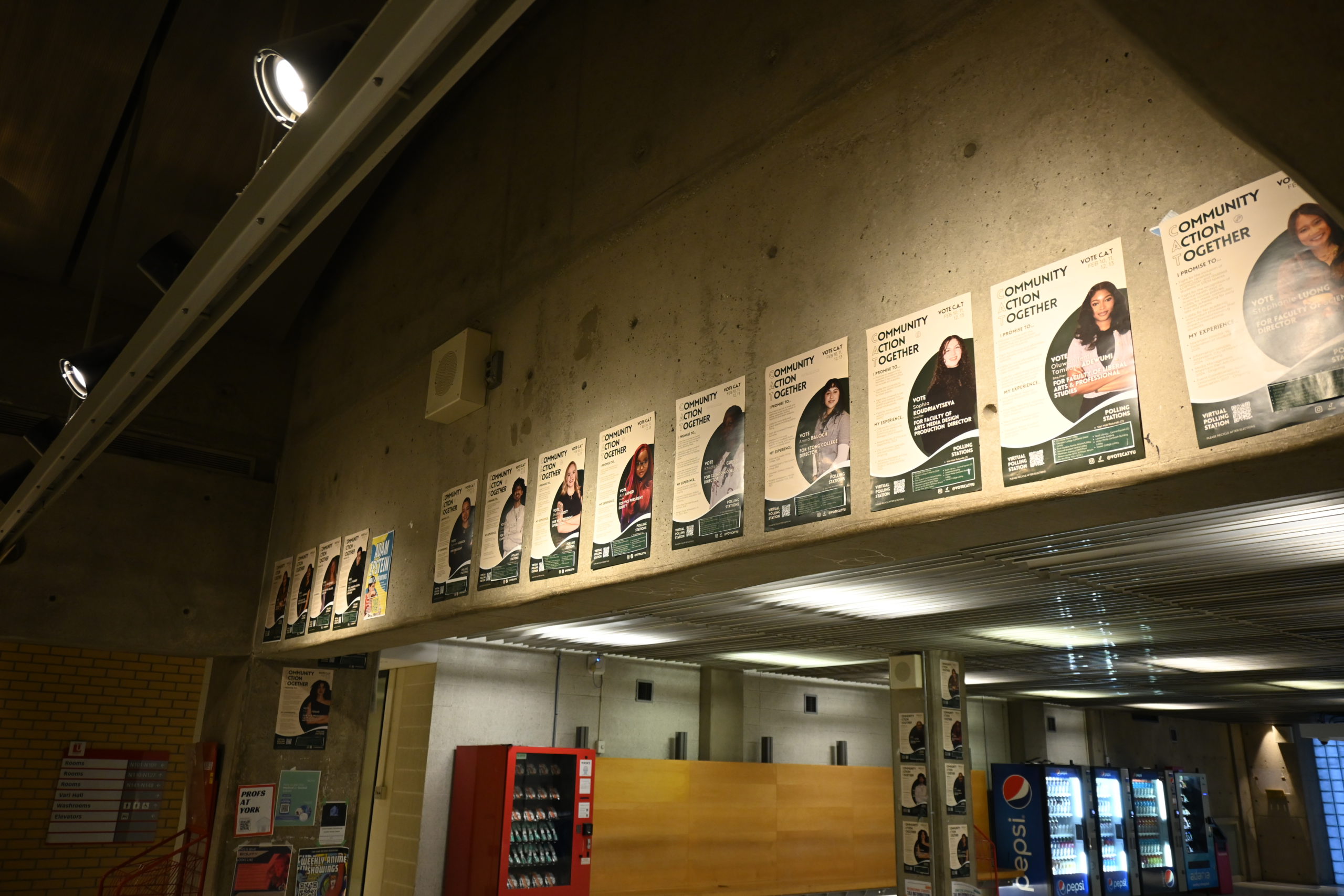
While on your way to lecture during the past week, you may have noticed campaign posters for the upcoming YFS general elections. Most visible were the swaths of green and beige designs that advertise the election’s only slate, Community Action Together (CAT). Led by current YFS VP Campaigns and Advocacy, Symone Lennon, CAT has a candidate running in each Executive and Director-at-Large position for a whopping total of 22 members. The old adage that there is strength in numbers has been taken to the extreme, and reveals weaknesses at the heart of how the YFS regulates their elections.
This is my third year at York, and the mental association I have between slates and the YFS’s general elections has only strengthened over time. Otherwise known as co- or cross-campaigns, the Federation allows these instances of multiple candidates endorsing one another for a common goal. Although slates are not the same as political parties, the consistency of certain representatives and stances between years can certainly create this impression among students.
The key benefit of a slate is the pooling of resources, financial and labour, to increase the visibility of all member candidates. This most clearly manifests itself as the walls of consistently branded CAT posters that undeniably leave a lasting impression on voters. More insidiously, it diffuses candidate scrutiny as the campaign promises of a united slate overshadow individual platforms.
One of CAT’s posters stuck out to me as I traversed Vari Hall: The candidate for Director-at-Large of my faculty, AMPD, had labelled themselves as seeking to represent the faculty of “Arts, Media, Design, and Production.” The latter two in that list are inaccurate; they should be “Performance” and “Design,” respectively. It’s not worthwhile to speculate which of CAT’s members had a hand in this error, but it reveals an overall unfamiliarity with even the basic traits of who they hope to have as constituents.
I had the opportunity to speak with Lennon about the backstory of CAT’s formation, and in particular about how she made the decision to accept each member. Lennon confessed that it was primarily on a first-come, first-serve basis — which makes sense given that many candidates face no opposition — and otherwise chose “whoever had more time to dedicate” to campaigning. Noticeably absent from Lennon’s description was any mention of discussing shared campaign goals.
When I first ran into Lennon and made my inquiries, she asked me to come along with her so that she could get approval from her campaign manager. This was an intriguing surprise to me, and I was soon face-to-face with Somar Abuaziza, moonlighting from her role as the YFS President. Abuaziza, according to Lennon, was showing her support by volunteering her expertise on the processes of running for the Executive position. The two share a similar political history of serving as the VP Campaigns and Advocacy before setting their sights on the spot of President. While Abuaziza appeared to shy away from any attention, her background support and presence serve as an endorsement of Lennon and the entirety of CAT.
Ultimately, CAT performs the role of an incumbent party and, intentionally or otherwise, frames individual campaigns as fringe opposition candidates that would impede their legislative efficacy. Student elections are already prone to operating as glorified popularity contests, and the visibility of Lennon, Abuaziza, and other candidates that are currently elected officials provide a hefty advantage in the battle to claim votes. It’s difficult to determine just how much each CAT member is genuinely invested in the team’s goals, or if they, too, recognized the convenience of shifting their campaign efforts to such heavy lifters.
Despite what the last four paragraphs may have led you to believe, my issue lies less with CAT and more with the systemic decisions that have enabled singular slates to dominate the YFS’s electoral landscape. U of T and TMU’s student unions, UTSU and TMSU, have significantly more restrictions in their governance which allow for a more diverse political environment.
UTSU has outright banned the formation of slates, and also demands that candidates involved with union operations take a leave of absence during the campaign period to avoid conflict of interest. TMSU, which allows slates, has a similar conflict of interest policy that requires all members of a campaign to abstain from union-related duties. Furthermore, they enforce the public disclosure of campaign managers for both slates and individual candidates.
Chief Returning Officer of the YFS, Sweydeep Kaur, informed me that the Federation does not have a formal campaign manager position, and instead only requires a list of campaign volunteers which do not have any “specific restrictions.” It should also be noted that during this campaign period, Lennon, Abuaziza, and other members of CAT have been fulfilling their current YFS roles, though there are bylaws that prevent them from having a presence on the Elections committee.
In an elegant solution to the poster-bombing issue, TMSU requires posters for the same slate to be at least one foot away from each other.
I’ll be the first to acknowledge my contrarian tendencies and desire for a good underdog story. Putting these aside, I still firmly believe that the ideal democracy is one that includes a variety of good-faith perspectives, and providing voters with genuine choice is the first step to achieving that ideal. For the YFS, this means amending their bylaws to encourage strong, independent candidate platforms that are visible to the student body.
Once again looking to our Toronto university peers, a good first step would be requiring and publishing written statements where candidates thoroughly explain their platform. For York undergraduates, it means getting more involved in the Federation’s legislative activities: attending meetings and debates, and considering candidacy.
When I cast a ballot for what will likely be my final time next year, I hope to have more than two boxes to decide between.

As a first year, deeply disturbed.
We can say it is an institutional failing of the YFS that CAT can do this all we want but at the end of the day, CAT is the group controlling YFS consistently, and blame falls on the not so neutral operators that dictate the institution